
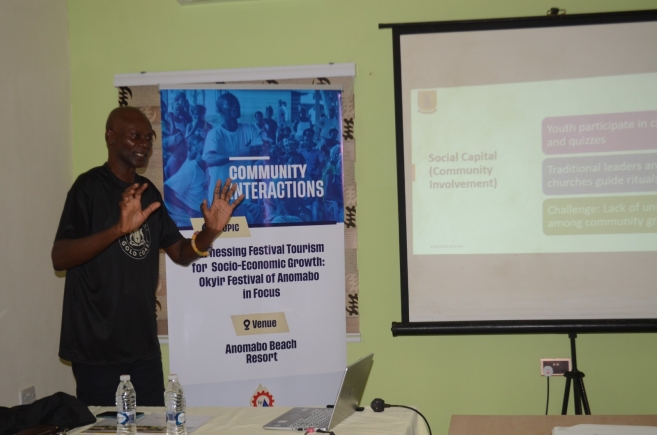
The project, generously sponsored by downstream oil company HUSS Petroleum, was conducted by Dr Theophilus Gyepi-Garbrah of the University of Gold Coast (formerly Accra Business School), and Professor Alexander Preko of the University of Professional Studies, Accra. In November 2025, the researchers collected both quantitative and qualitative data from residents of Anomabo on their experiences and perceptions of the festival.
On January 21, 2026, a validation session was held in Anomabo to present the findings. The forum brought together key stakeholders, including members of the festival planning committee, assembly members, community leaders, women, youth, as well as representatives from the Ghana Fire Service and the Ghana Tourism Authority. The session provided an opportunity for participants to deliberate on the findings and discuss practical recommendations.
Ahead of the next Okyir Festival, scheduled for October this year, the research team plans to return to Anomabo to conduct community awareness and training sessions for schoolchildren and young people, focusing on personal safety and responsible behaviour during the festival.
The study examined how the influx of tourists and increasing commercialisation of the festival are subtly eroding traditional cultural values, particularly among the youth. While acknowledging that the festival boosts the local economy and strengthens community pride, the researchers found that it is also associated with rising social challenges, including alcohol and drug use, teenage pregnancy and the dilution of traditional practices.
“Our findings revealed a shift in focus from cultural heritage to pure entertainment,” said Professor Preko. “Many youths are adopting foreign styles of dressing and behaviour, often sidelining the very traditions the festival seeks to uphold.”
The researchers observed that local values are increasingly under pressure from what they described as the “demonstration effect”, where residents imitate the behaviours of tourists, both positive and negative. Several respondents expressed concern about the erosion of cultural rituals and the declining authority of elders and traditional leaders within the community.
Dr Gyepi-Garbrah emphasised that although festival tourism brings undeniable economic benefits, there is an urgent need for more sustainable planning, stronger stakeholder support and deliberate policy advocacy to safeguard cultural heritage.
“A multi-source revenue model should be pursued and incomes reinvested into community development and cultural education,” he noted.
The study recommends proactive community involvement, intensified youth education, stronger local bylaws, and closer partnerships with non-governmental organisations and local authorities to preserve the cultural integrity of festivals while still harnessing their economic potential.
As Anomabo prepares for future editions of the Okyir Festival, the research serves as a timely reminder and a clarion call for stakeholders to strike a better balance between tourism-driven growth and the preservation of cultural identity.