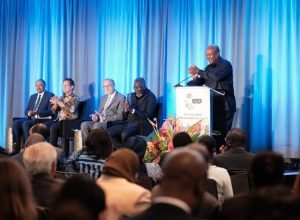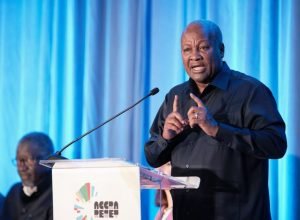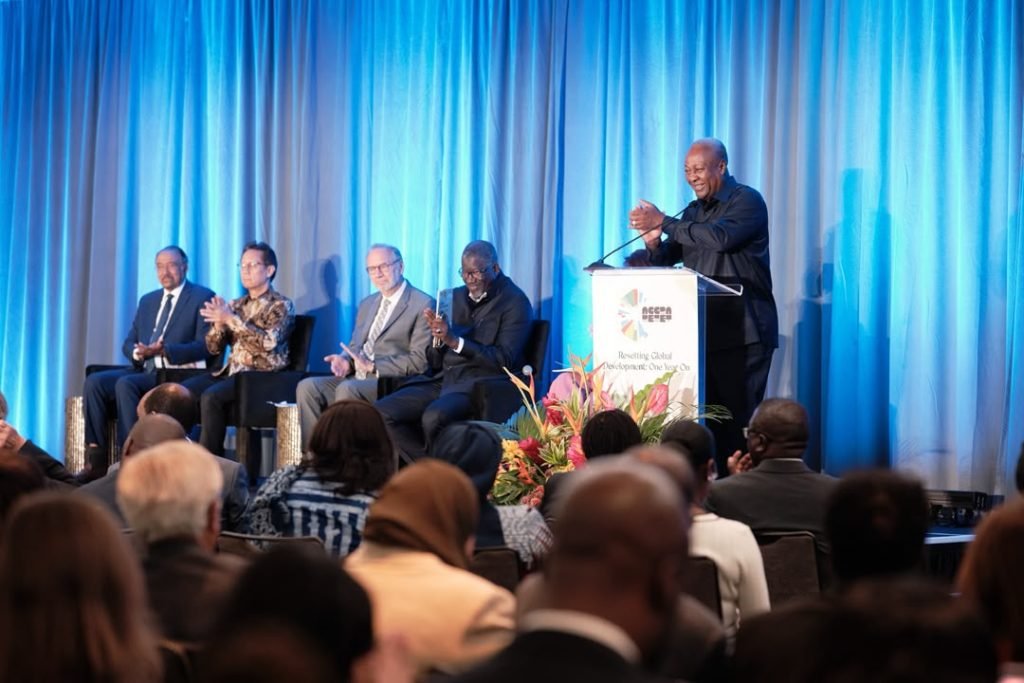
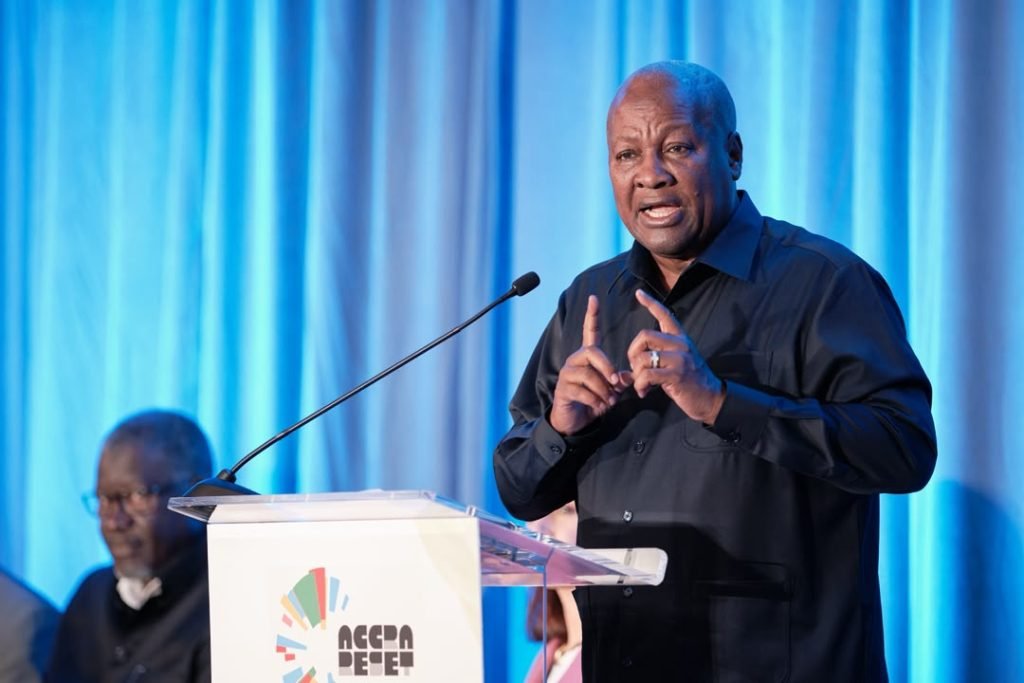
Speaking at the Accra Reset Conference on the sidelines of the 81st UN General Assembly in New York last Monday, President Mahama said although developing countries won political independence decades ago, the levers of power remained anchored elsewhere.
“In 1955, 29 nations gathered in Bandung demanding a seat at the world’s table.
We won political independence; we raised our national flags and sang our anthems.
Yet, the levers of global trade, finance, health and governance remained firmly anchored elsewhere,” he said.
The President said in 2005, the world again met in Paris and crowned “country ownership” as the guiding principle of development cooperation, but in reality, developing nations were handed a broken cauldron.
“It was a pleasant phrase. But in truth, we were handed a broken cauldron; we were asked to own soup cooked entirely in someone else’s kitchen.
For decades, nations of the Global South have been asked to own the results of health and development programmes, while others retain the control,” he said.
“Today, through the Accra Reset, we declare unequivocally that there can be no ownership without control,” he added.
President Mahama, however, cautioned that moving power from distant boardrooms in Geneva or Washington into unaccountable ministries in Accra, Abuja or elsewhere would not guarantee sovereignty.
“If we demand control, we must earn it through uncompromising domestic accountability. In our Resetting Ghana Agenda, we are tightening fiscal controls, fighting corruption and ensuring that every public cedi is accounted for down to the last pesewa,” he said.
President Mahama described the principle as “no ownership without control, but no control without absolute accountability to our people”, emphasising that it was the bedrock of a new global bargain, namely responsibility matched by authority, authority backed by productive capability, and partners held accountable.
He also launched the Accra Reset report dubbed “Sovereign Future for Health”, which contains 10 practical recommendations to move from design to execution.
The Accra Reset is a Ghana-led global framework championed by President Mahama as African Union Champion for African Financial Institutions to re-engineer global development financing and governance.
Launched at a high-level side event during the 80th UN General Assembly in New York in September last year and co-convened by former Nigerian President, Olusegun Obasanjo, the initiative responds to what President Mahama described as a “fraying” global development architecture where COVID-19 erased two decades of progress in two years, where climate shocks put over 700 million people at risk of hunger, and many developing countries spent more on debt servicing than health and education.
It is anchored on three principles, namely “sovereignty, workability and shared value”, and seeks to end Africa’s triple dependency on foreign powers for security, external donors for social services and external firms for mineral value chains.
Health was chosen as the entry point and proof of concept, moving from aid dependency to health sovereignty.
It builds on the Africa Health Sovereignty Summit held in Accra in August 2025.
In April 2026, the Reset’s chancery announced an 18-member High-Level Panel co-chaired by Peter Piot, El Hadj As Sy, Nisia Trindade and Budi Gunadi Sadikin to produce concrete proposals to restructure a global health order that has treated the Global South as passive takers rather than sovereign actors.
President Mahama said over the coming months, Ghana and the Presidential Council would convene governments, global health bodies, development finance institutions, philanthropies and the private sector to translate the recommendations into country-level compacts.
He said Ghana was inviting strategic partners — from Brazil’s Fiocruz to leading institutions in India, Indonesia, the Gulf and across Africa — to build self-sustaining networks linking research, regulatory oversight, local manufacturing and distribution.
The President stressed that the sovereign health agenda was not isolationism, but pragmatic interdependence.
“We are seeking pragmatic interdependence: a mature, equal partnership where we see one another as equals.
Stronger, self-reliant Southern partners are not a threat to the Global North.
Resilient health systems in Africa and Asia make the entire world safer,” he said.
President Mahama said structural reform could not wait for geopolitical tensions to ease, stressing that crisis was when new paradigms were forged.
He said health was chosen as the first battleground for the reset, with maternal and child health as the first test, given that nearly seven out of 10 maternal deaths occurred in Sub-Saharan Africa.
He cited the Mother Africa initiative championed by President Samia Suluhu Hassan of Tanzania and the Business United for Mothers, Babies and Youth campaign as models that would stress-test the new architecture.
President Mahama said his government was prepared to assume the chairmanship of the African Union in 2027, and then carry the Reset Agenda into Africa’s collective policy framework.
He thanked France, Spain, the United Kingdom, the G77, the OECD, the Commonwealth and former British Prime Minister, Gordon Brown, for mobilising global political leadership around the bargain.