The Ebola outbreak in the Democratic Republic of Congo and Uganda, which has left at least 88 people dead, was declared a public health emergency by the World Health Organization on Sunday.
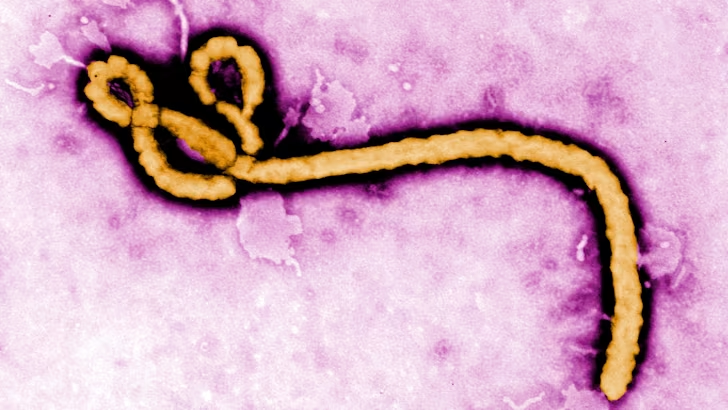
Ebola is a highly contagious virus that can be contracted via bodily fluids such as vomit, blood or semen.
The disease it causes is rare, but can be severe and often fatal.
In a post on X, the World Health Organisation (WHO) said the outbreak does not meet the criteria of a pandemic emergency, like Covid-19, and advised against the closure of international borders.
What is Ebola and why is this strain particularly concerning?
There are six known virus species that can lead to Ebola, but only three cause most large outbreaks: Ebola virus, Sudan virus and Bundibugyo virus.
The latest epidemic is driven by the latter, the less common Bundibugyo virus, for which there is currently no cure and no licensed vaccines.
There are also no vaccines in late-stage clinical development that could be readily deployed during the outbreak.
Although more than 20 Ebola outbreaks have taken place in Congo and Uganda, this is only the third time that the Bundibugyo virus has been detected.
Dr Anne Cori, Associate Professor in Infectious Disease Modelling at Imperial College London, said:
“There is limited scientific evidence on this Ebola species as there are only two historical outbreaks recorded.
These point to a highly lethal disease with an estimated 1 in 3 cases dying.”
What are the symptoms?
Symptoms of Ebola often include fever, fatigue, muscle pain, headache and a sore throat, followed by vomiting, diarrhoea, abdominal pain, among others.
Internal and external bleeding can occur later as the disease progresses.
The incubation period of Ebola ranges from two to 21 days, with an average of eight to 10 days.
Where is the outbreak and how many people have tested positive?
WHO said the outbreak is impacting the DRC’s remote northeastern Ituri province on the border with Uganda.
Cases have also appeared in the Congolese capital, Kinshasa, and in the city of Goma.
The US Centres for Disease Control and Prevention (CDC) has reported at least 10 confirmed cases, and at least 336 suspected cases, including 88 deaths in the DRC.
Two laboratory-confirmed cases have now been reported in Uganda, including one death.
The two cases had no apparent link to each other, but the individuals had travelled from the DRC.
The Congolese health minister has announced the opening of three treatment centers in eastern Congo.
Why are experts worried?
This is a concerning outbreak for several reasons, according to Dr Daniela Manno, Clinical Assistant Professor at the London School of Hygiene & Tropical Medicine (LSHTM).
Dr Manno said “transmission may have been ongoing for several weeks before the outbreak was formally recognised” and that the outbreak is occurring in “a region affected by insecurity, population displacement, and high population mobility, all of which can complicate surveillance, contact tracing, and delivery of healthcare”.
Previous Ebola outbreaks in the region have lasted as long as two years.
However, it is not uncommon in the region, and Dr Manno says the outbreak response capacity has gotten stronger.
Why is it a global health emergency?
A Public Health Emergency of International Concern (PHEIC) is the highest level of international public health alert that WHO can declare under the International Health Regulations.
However, experts highlight that this does that the outbreak is globally uncontrollable.
Dr Amanda Rojek, Associate Professor of Health Emergencies at the University of Oxford, said:
“The declaration of a PHEIC does not immediately change the reality on the ground. What it does do is signal to the international community the need to pay attention to this outbreak and support a well-coordinated response.”
WHO previously declared a PHEIC during the large Ebola outbreak in North Kivu and Ituri provinces in DRC between 2018 and 2020, and before that during the 2014–2016 West Africa Ebola epidemic.