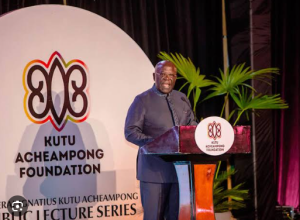
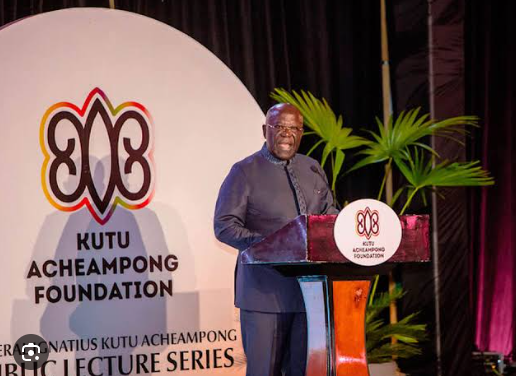
Speaking at the Kutu Acheampong Lectures last Friday, on the theme:
“Breaking the Silence:
The Human and Political Complexities Behind the Leadership of General Acheampong”, the respected businessman said Ghana’s winner-takes-all system had turned every election into a four-yearly war.
He cited the 2024 Afrobarometer survey which indicated that three in four Ghanaians believed democracy was the best form of government, but fewer than half were satisfied with the democracy they actually had, while the share of the population willing to consider a non-democratic alternative had doubled since 1999.
“That is not a people rejecting democracy; it is a people asking why their democracy does not deliver.
Acheampong doubted that the adversarial winner-takes-all form we imported was fit for purpose in most African countries at this stage of development.
This is not a call for less democracy. Elections, accountability and a free press must stay.
It is a call for a better designed one,” Dr Jonah said.
Dr Jonah argued that winner-takes-all assumed that voters who could choose between competing programmes and institutions were strong enough to referee.
“Where too many voters are poor, a vote is too easily bought with a bag of rice and a t-shirt, and the money that buys it is recovered afterwards through contracts,” he said.
“Where opportunities are unequal, campaigns are fought along tribal and regional lines because identity knows no argument,” he added.
The result, he said, was a system where the state changed hands like a relay baton dropped rather than passed, with flagship projects abandoned mid-construction because they carried the wrong party’s name, and a loser incentivised to hope the country failed until the next election.
Dr Jonah said his proposed new union government would not be Gen. Acheampong’s 1978 Union Government imposed from above, in uniform, around one man.
“Unity cannot be imposed; it must be agreed by the parties, by Parliament, and finally by the people, in a vote that is free and counted honestly,” he said.
As a blueprint, he added that the period of national stability would be established by an Act of Parliament passed by two-thirds majority and approved by the people in a referendum.
It would run for two full parliamentary terms, then end automatically.
It could be renewed only by another referendum, and it could not extend the term of any president or MP by a single day.
Dr Jonah explained that Ghanaians would still choose their president and MPs on the same calendar period, under the same Electoral Commission.
The winner would still be president; but winning would change meaning.
“Winning would mean the right to lead the nation, not the right to own the state,” Dr Jonah said.
He added that every party that won at least a tenth of seats in Parliament would be entitled to Cabinet posts in proportion to its seats.
With the Constitution capping Cabinet at 19 ministers, a party with 40 per cent of seats would get roughly eight ministers.
He further added that the leader of the second party would become Senior Minister with a statutory seat at the table.
Ministers would be nominated by their parties, vetted by Parliament, and the President could set a nominee aside only for good cause.
“I’ve chaired boards where directors hate each other but they still sign accounts because the company matters more than the quarrel,” Dr Jonah said.
The business mogul added that no region should be left out, and that the Cabinet as a whole should reflect the face of the nation.
Dr Jonah further stressed that before the period began, parties would agree and Parliament would enact a National Development Compact which should be a short list of priorities with measurable targets for food, energy, industry, skills and infrastructure, based on the National Development Planning Commission’s long-term plan.
“A project in the compact could not be abandoned because a new minister arrives.
Heads of public boards and agencies would be appointed on merit for fixed terms that don’t end on election night,” he stated.
As the last of the six blueprints, he added that accountability must survive.
He proposed that the Public Accounts Committee (PAC) of Parliament would be chaired by a member from outside the governing parties, and stressed that the Electoral Commission and the press would remain free as the compact could not touch fundamental rights or term limits.