
Why has India suddenly banned Telegram?
Indian government cracks down on channels on the Telegram app offering fake entrance exam questions for a hefty fee
The Indian government has temporarily blocked the Telegram messaging app ahead of the re-examination of the country’s biggest medical entrance exam.
The federal ministry of education on Tuesday said Telegram has been banned until 22 June after it emerged that the app had been used to “defraud candidates” taking the medical entrance examination.
At least 2.3 million aspiring doctors will retake the National Eligibility Entrance Test (Neet) on 21 June across cities in India after the entrance test was cancelled in May following the alleged leak of the question paper.
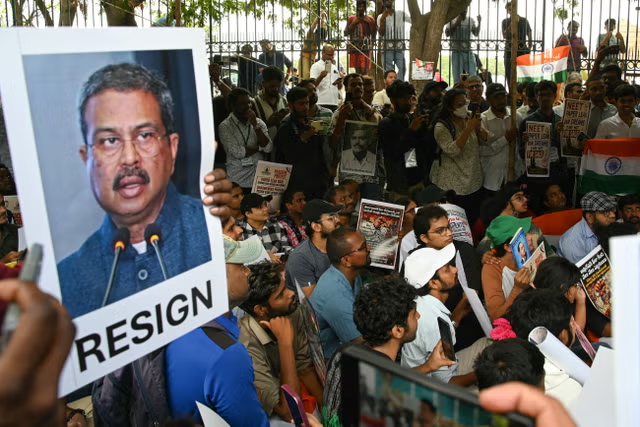
The cancellation triggered nationwide protests led by the viral Cockroach Janata Party amid growing demands for education minister Dharmendra Pradhan’s resignation over his department’s failure to handle the Neet and other crucial school-leaving examinations.
The restriction on Telegram was issued under a stringent provision of the IT law, which empowers the government to block access to online sites in the “interest of sovereignty and integrity of India”.
The measure was taken “in response to the organised use of the platform by cheating rackets to defraud candidates appearing for the NEET 2026 re-examination scheduled on 21 June 2026,” said the education ministry’s National Testing Agency (NTA).
The ministry has also instructed the messaging platform to disable its message-editing feature in the country until the end of June.
The testing agency alleged that the app’s message-editing feature has been used to create misleading “paper leak” evidence after the exam.
The agency claimed that the editing feature allowed admins to edit old posts after the exam to add the question papers, while retaining the original timestamp, thereby falsely suggesting a pre-exam leak.
The testing agency claimed that prior to the re-examination, several Telegram channels were created to sell false Neet questions to scam aspirants.
The channels demanding money from candidates in exchange for fake question papers were taken down, officials said.
At least two people were arrested in India’s western city of Ahmedabad for cheating students by falsely promising access to the question paper.
The education ministry said it “regrets the inconvenience caused” due to the blocking of the app that will affect hundreds of thousands of people but the measure of “last resort,” as the earlier action to take down such content from the platform “had not produced” results.
Telegram has grown rapidly in India and the country is its biggest market by downloads, although WhatsApp remains the dominant messaging platform.
That makes the temporary restriction a rare and sweeping intervention for a service used well beyond politics and news.
Following the Neet debacle, the education minister said that the Narendra Modi government was taking extensive measures to conduct a rerun, including the use of Air Force aircraft to transport the exam material securely to avoid further leaks.
The ministry has also placed those involved in the setting of the Neet question paper, moderators and translators under lockdown at an undisclosed location to prevent further leaks.
Mobile phones, laptops, smartwatches, and other communication devices have been banned, while internet access and external communications have been tightly restricted for those in forced isolation.
Entry to and exit from the facility are being closely monitored and recorded, with access limited to authorised personnel, according to reports.