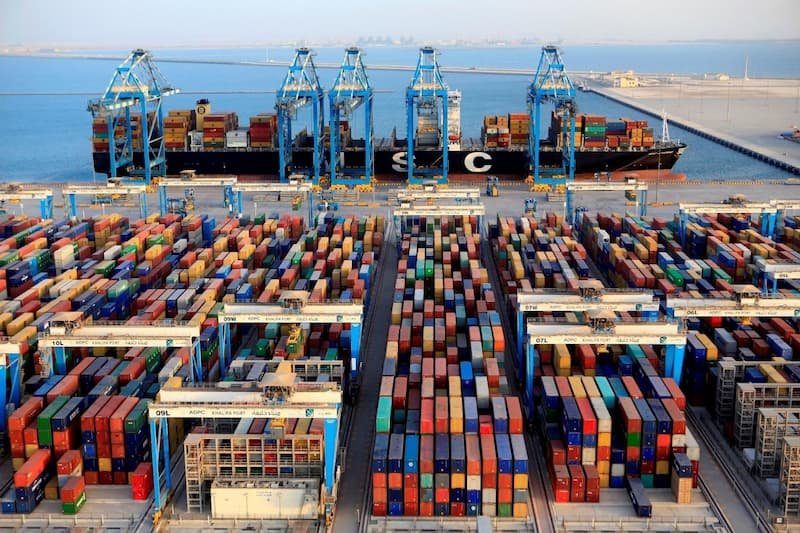
The data, published in the Q4 2025 Trade Newsletter, showed that the aggregate value of Ghana’s external trade reached GH¢170.1 billion during the quarter, comprising exports valued at GH¢108.6 billion and imports amounting to GH¢61.4 billion.
The surplus represented a significant increase of 29.7 percentage points compared to the GH¢16.7 billion surplus recorded in the third quarter of 2025.
In US dollar terms, total trade was valued at US$15.1 billion, with exports of US$9.7 billion and imports of US$5.5 billion, resulting in a trade surplus of US$4.2 billion.
Gold remains dominant export
Gold bullion remained the country’s top export product, valued at GH¢72.7 billion in Q4 2025, accounting for 66.9 per cent of total exports.
This was more than seven times the value of the second-highest export, cocoa beans, which recorded GH¢9.6 billion. Crude petroleum followed with GH¢7.6 billion.
The share of gold in total exports, however, declined from 73.4 per cent in Q3 2025 to 66.9 per cent in Q4, while the share of cocoa beans and related products increased from 5.5 per cent to 13.9 per cent over the same period.
For the full year 2025, gold bullion accounted for 62.9 per cent of total exports, followed by cocoa beans at 8.6 per cent and crude petroleum at 8.3 per cent.
Imports dominated by mineral fuels
On the import side, motor spirit, super, was the leading import product in Q4 2025, valued at GH¢6.4 billion, accounting for 10.4 per cent of total imports.
Gas oil followed with GH¢4.5 billion, representing 7.4 per cent. Used vehicles with engine capacity between 1500cc and 3000cc ranked third with GH¢3.1 billion.
Mineral fuels and oils accounted for 24.0 per cent of total imports in Q4, down from 25.1 per cent in the previous quarter. The import share of vehicles and automotive parts increased by 2.0 percentage points.
For the full year 2025, gas oil was the leading import product, accounting for 11.2 per cent of total imports, followed by motor spirit, super, at 9.2 per cent.
India and UAE lead export destinations
In Q4 2025, India emerged as Ghana’s largest export destination, accounting for GH¢27.2 billion or 25.0 per cent of total exports, followed by the United Arab Emirates with GH¢24.8 billion or 22.8 per cent. South Africa, Switzerland and the Netherlands completed the top five destinations, collectively accounting for 74.8 per cent of total exports.
China remained the primary source of imports, supplying GH¢14.3 billion, representing 23.3 per cent of total imports, followed by the United States of America with GH¢5.3 billion.
Africa trade surplus maintained
Ghana maintained a trade surplus with Africa throughout 2025, with the highest surplus recorded in the first quarter. Exports to the continent were dominated by gold bullion, contributing 57.1 per cent of total exports to Africa in Q4, followed by crude petroleum at 7.3 per cent.
South Africa remained Ghana’s leading African export destination, accounting for 63.8 per cent of total exports to the continent, while Nigeria led as the primary import origin, accounting for 33.6 per cent of imports from Africa.
Price trends and real trade
The Export Unit Value Index stood at 361.9 in Q4 2025, while the Import Unit Value Index was 193.6.
Year-on-year, export prices increased by 0.91 per cent, while import prices fell by 24.9 per cent. On a quarterly basis, export prices surged by 23.2 per cent, driven largely by a 31.6 per cent increase in gold prices.
In real terms, however, the trade balance showed a deficit, with real exports valued at GH¢30.0 billion and real imports at GH¢31.7 billion, reflecting the impact of inflation on purchasing power.
Policy recommendations
The Statistical Service noted that Ghana’s heavy export concentration in gold, petroleum and cocoa exposes the economy to commodity price volatility and supply disruptions.
It recommended enhancing intra-African trade through the AfCFTA, diversifying export markets and products, developing trade-related infrastructure, and promoting value-added processing for cocoa and minerals.