“We want to train industry-ready engineers and agricultural scientists to help with the industrialisation of the nation, address food security and create jobs for the youth,” the Vice-Chancellor of UEAS, Professor Mark Adom-Asamoah.
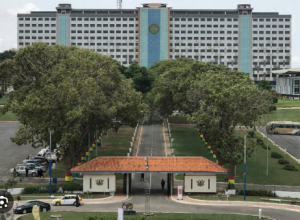
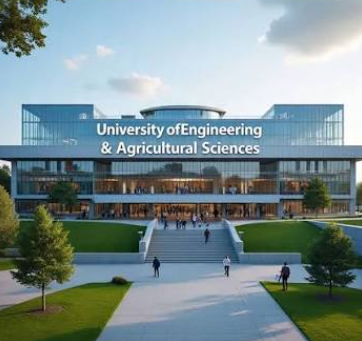
Located at Bunso in the Eastern Region, it is the first fully-fledged university that integrates engineering, agricultural science, innovation and entrepreneurship to train hands-on industry-ready graduates in agriculture and engineering.
UEAS is set up under the University of Engineering and Agricultural Sciences Act, 2026 (Act 1169).
The university aims to become a centre of excellence in engineering innovation and agro-entrepreneurship, and the leading institution of its kind in Africa.
Prof. Adom-Asamoah, who led a three-member delegation of UEAS to pay a courtesy call on the Editor, Graphic, Theophilus Yartey, said the university had been designed to respond to some of the major development challenges confronting the country, particularly industrialisation, food security and youth unemployment.
Unlike the conventional approach where students in different disciplines are trained separately, the Vice-Chancellor said the university would deliberately bring engineering and agricultural science students together to develop practical solutions to agriculture and agribusiness.
The well-planned university’s campus at Bunso has been developed with a $92-million Korean Exim Bank loan.
With facilities, including faculty buildings, two major buildings for classes, laboratories, an administration block, a library, halls of residence and staff accommodation, Prof. Adom-Asamoah described the campus as the best-planned university campus in the country.
The Minister of Education, Haruna Iddrisu, inaugurated the Governing Council and the Core Management Team of UEAS on Tuesday, May 12, 2026, with a mandate to officially operationalise the University for the 2026/2027 academic year.
Before the end of the year, President Mahama is expected to inaugurate the university, which will admit its first cohort of students next month.
The university will initially operate two schools — the School of Engineering and the School of Agricultural Science.
The School of Engineering will offer Bachelor of Science programmes in Electrical and Electronic Engineering, Computer Engineering, Mechanical Engineering and Industrial Engineering.
The School of Agricultural Science will offer programmes such as Agronomy, Animal Science, Agricultural Economics and Agribusiness, and Food Technology and Nutrition Science and
This means students of agriculture would do core courses such as agronomy from the first year through to the fourth year, unlike traditional universities where students electe to study courses or select their majors only after the first year.
Prof. Adom-Asamoah explained that the university’s Innovation Centre, for instance, would serve as a major platform for students to combine knowledge from engineering and agriculture to develop new technologies and solutions.
He indicated that students would have access to machinery and other facilities at the centre to conduct experiments, design and develop innovations.
The Vice-Chancellor explained that in developing smart agriculture systems, for instance, engineering students would develop the technology for irrigation, while agricultural science students would provide the technical knowledge on when crops required water based on factors such as temperature and other agronomic conditions.
“That is called smart agriculture.
So, we want to bring all of them together,” he said.
Prof. Adom-Asamoah said the approach was intended to move tertiary education beyond the traditional emphasis on theoretical knowledge to equipping students with the ability to apply what they learnt to solve practical national problems.
The Vice-Chancellor said another feature that would distinguish the university was the strong emphasis on entrepreneurship and leadership development.
He said the university would, therefore, introduce a residential system, modelled on systems used by institutions such as Oxford and Cambridge universities and some universities in the United States.
Under the system, students would receive additional training outside the conventional classroom curriculum in areas such as time management, financial management, peaceful coexistence and constructive argument.
For his part, the Pro Vice-Chancellor of UEAS, Prof. Dominic Otoo, said the institution’s visit to the Graphic Communications Group Ltd was intentional as part of efforts to seek media support for its programmes and activities.
The Registrar, Dr Paul Kwadwo Addo, also said all the programmes offered by UEAS had been duly accredited by the Ghana Tertiary Education Commission (GTEC).
He said the UEAS had assembled experienced academics from existing public universities, stressing that UEAS would not become a “trial and error” institution.
Mr Yartey said partnerships and collaborations underlay Graphic’s 76 years existence and stood ready to work with the university for their mutual benefits.
“We also collaborate with other corporate bodies, and that is why we have the Stanbic-Graphic Business Breakfast Meeting, which is held four times a year,” he said.
“People can vouch for our credibility which we don’t take for granted,” Mr Yartey said, adding that the company had evolved into a major player in the digital space.